
What Is an SMS Gateway and How Does It Work?
Last time you got an OTP, you probably just typed it in and moved on. Nobody stops to think about how that 6-digit code found its way to your phone in under 5 seconds. That’s the SMS gateway doing its job – quietly, reliably, every single time.
In this post, I’m breaking down exactly what it is and how the whole thing works. Lets start.
What is an SMS gateway?
Think of it as the post office for text messages.
Just like a post office takes your letter, figures out the route, and delivers it to the right address, an SMS gateway takes your message, finds the right network path, and delivers it to the right phone number.
When a business wants to send an SMS to thousands of customers, it can’t just grab a phone and start typing. It needs a system that connects its software/website/app to the customers’ mobile network – and that system is called SMS gateway.
The term “gateway” is accurate: it sits between two very different worlds – the internet-based apps and software on one side, and the mobile networks on the other. It handles all the translation, routing, and compliance that make that connection possible.
How does an SMS gateway work – step by step
The whole process looks fast from the outside (it usually takes less than 7 seconds), but there’s actually quite a bit happening behind. Here’s what goes on from the moment a message is triggered to when it lands on receiver’s phone.
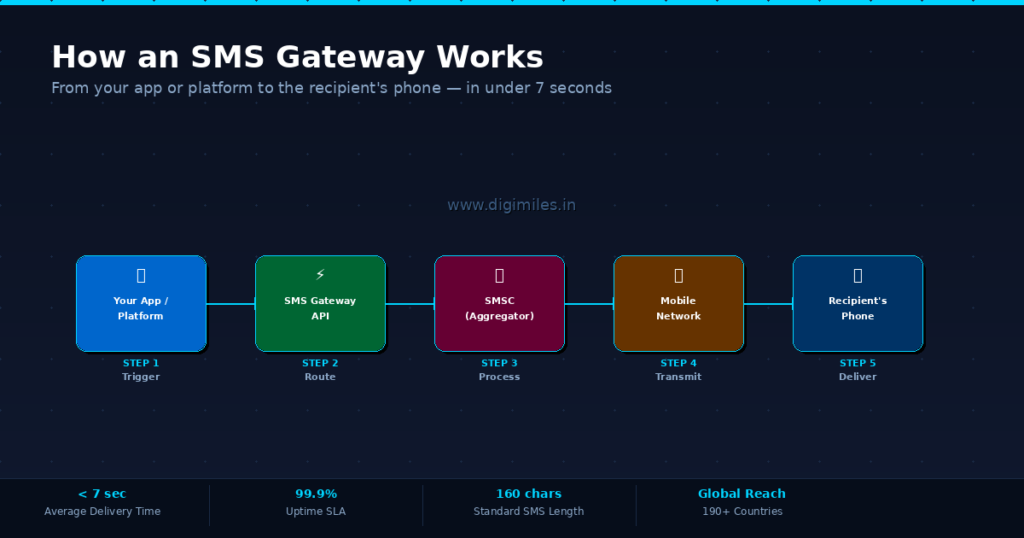
Step 1: Your platform triggers the message
It starts with an event – like a customer completing a purchase or requesting a password reset or a scheduled campaign goes live.
Your software calls the gateway’s API with the recipient’s number, the message content, and the sender ID you want to use.
Step 2: The gateway receives and validates the request
The gateway checks a few things before doing anything: Is this a valid phone number? Is the message content registered under DLT? Does the sender have enough SMS credits? Are there any carrier restrictions for this number? This validation step prevents most failures.
Step 3: Routing through the SMSC
Once validated, the message gets passed to an SMSC (Short Message Service Centre) – basically the carrier’s internal server that stores and forwards SMS messages. If the recipient’s phone is off or out of coverage, the SMSC holds the message and retries delivery for a set period (usually 24–72 hours).
Step 4: The carrier transmits to the device
The SMSC hands the message to the recipient’s mobile network, which pushes it to their device over the radio network. This part happens almost instantly when the phone is online.
Step 5: Delivery confirmation comes back
Once the message lands on the device, a delivery receipt (DLR) travels back through the same chain in reverse. Your platform receives a “delivered” status update via the gateway. If something went wrong, you’ll get a failure code – which helps with troubleshooting and retry logic.
💡 Worth knowing: Good SMS gateways give you real-time delivery reports. If you’re sending OTPs or transactional alerts, that delivery reports are critical – you want to know immediately if a message didn’t get through.
Types of SMS gateways
Not all gateways are built the same way, and the type you use matters depending on your use case and volume.
| Type | How it works | Best for |
|---|---|---|
| API-based gateway | You integrate via REST or HTTP API. Your software makes direct calls. | Developers, high-volume apps, automated messaging |
| Web-based gateway | Browser dashboard – no coding needed. Upload contacts, compose, send. | Small businesses, marketing teams, one-off campaigns |
| SMPP gateway | Uses the SMPP protocol for direct telco-level connection. Fast, low-latency. | Enterprise senders, very high volumes (millions/day) |
| Email-to-SMS gateway | Send an email to a special address; it gets converted into an SMS. | Legacy systems, internal notifications |
For most businesses, an API-based gateway offers the right balance of flexibility and reliability. You can automate everything – from OTP delivery to post-purchase follow-ups, without manual effort.
Why businesses actually need an SMS gateway
You might wonder – can’t you just use a phone or WhatsApp Business? For a handful of messages, maybe. But the moment you’re sending at any real scale, or need automation, or care about delivery reliability, you need a proper gateway. Here’s why:
- Scale without manual effort – send 10 or 10 million messages the same way, programmatically
- Delivery reliability – enterprise gateways have direct operator connections and fallback routes
- Real-time analytics – delivery rates, campaign reports
- Regulatory compliance – DLT registration, DND filtering
- API integration – plug into your CRM, e-commerce store, or internal tools
- Cost efficiency – bulk pricing per SMS is far cheaper than any manual alternative
Businesses use SMS gateways across practically every industry – banks use them for OTPs, hospitals use them for appointment reminders, e-commerce stores use them for order updates, and HR teams use them for employee alerts. The use cases are almost limitless.
How to choose the right SMS gateway
There are literally hundreds of SMS gateway providers out there, and the differences between them can be significant. Here’s what actually matters when you’re evaluating one:
Delivery rate and uptime
This is the most important metric. A gateway that can’t reliably get messages through isn’t worth much, no matter how cheap it is. Look for providers that offer 99.9%+ uptime SLAs and can share delivery rate benchmarks for your target regions.
Direct carrier connections vs. grey routes
Some low-cost providers use ‘grey routes’ – unofficial paths through the network that are cheaper but unreliable and often non-compliant. You need to verify the routes they use so your messages wont get blocked once purchased.
API quality and documentation
Your developers need a simple and easy-to-understand API. So make sure the provider offers good documentation, clear error codes and a responsive sandbox environment. If the API docs are confusing or outdated, that’s a warning sign you need to consider.
Compliance support
For businesses in India, DLT compliance is mandatory. Your gateway should have a knowledgeable team to onboard you with DLT.
Pricing structure
You need to compare per-SMS rates, but also look at how pricing scales with the no. of credits. Some providers charge extra for API usage. Understand the full cost and benefits before committing big.
Frequently asked questions
Q. What’s the difference between an SMS gateway and an SMS API?
They’re related but not the same thing. An SMS gateway is the underlying infrastructure that connects to telecom networks. An SMS API is the interface through which your software talks to that gateway.
Q. How long does it take for an SMS to be delivered?
For most messages on a quality gateway, delivery happens in under 10 seconds when the recipient’s phone is online. If the phone is off or unreachable, the SMSC will retry for 24–72 hours before marking it as undeliverable.
Q. Is an SMS gateway secure?
Reputable SMS gateway providers encrypt data in transit, use authenticated API access (via keys or OAuth), and maintain compliance with data protection regulations.
